
You haven't changed your diet. You might even be eating less than you used to. You still go for walks, you still try to stay active. Yet, the scale slowly creeps up, and the fat seems to accumulate exclusively around your midsection.
If this sounds familiar, you are experiencing the realities of an aging metabolism. The calories-in, calories-out equation hasn't changed, but your body's definition of "calories out" certainly has. Let's look at the three biological reasons why weight loss becomes a completely different game after age 40.
1. Sarcopenia: The Silent Muscle Thief
Starting in our 30s, we begin to lose between 3% and 8% of our muscle mass per decade—a process called sarcopenia. By the time you hit 40, this loss accelerates significantly if you aren't actively resistance training.
Why does this matter for weight loss? Muscle tissue is highly metabolically active. It burns calories even when you are sitting on the couch doing absolutely nothing. Fat tissue, on the other hand, burns almost nothing. When you lose muscle mass, your Basal Metabolic Rate (BMR)—the amount of energy your body needs just to stay alive—drops.
If your BMR drops by 150 calories a day due to muscle loss, and you continue to eat the exact same amount of food you ate in your 20s, those unburned 150 calories will be stored as fat. Over a year, that translates to gaining 15 pounds of pure fat, without changing a single eating habit.
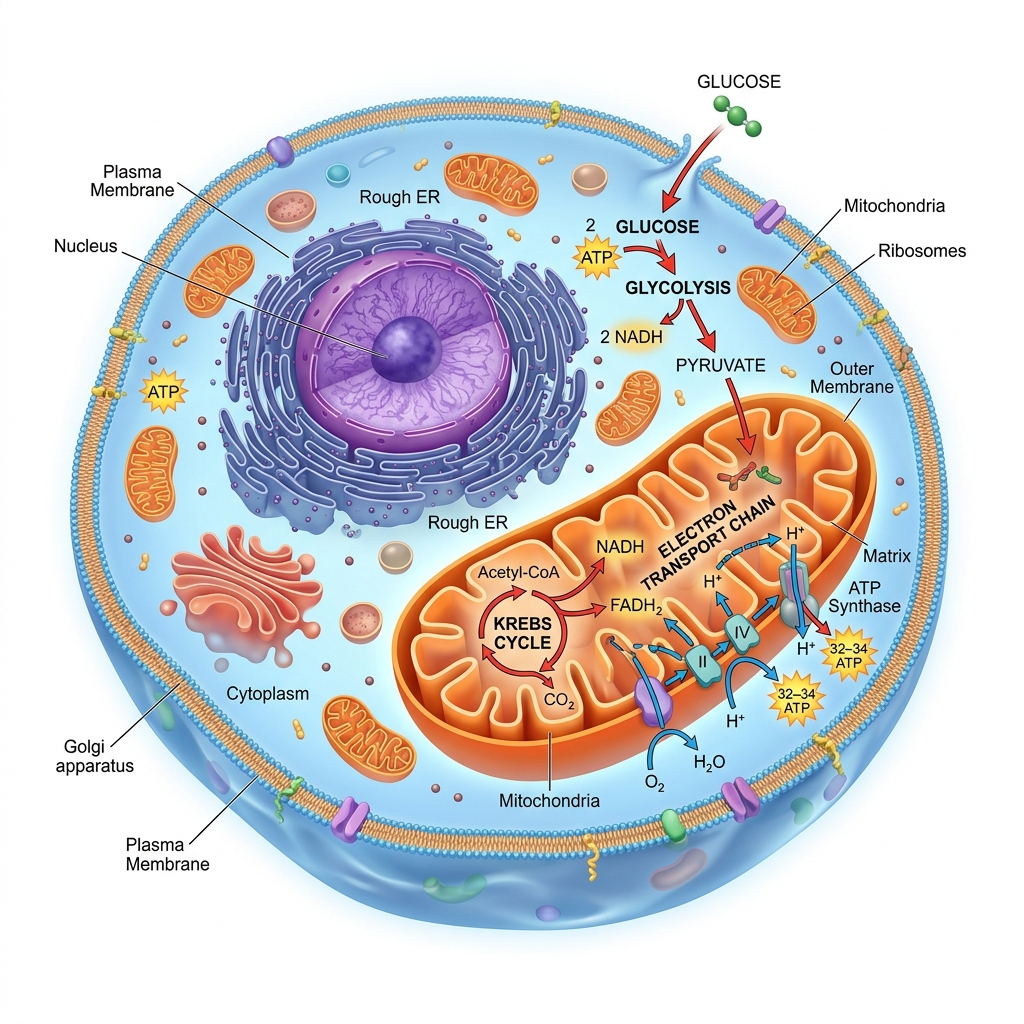
Mitochondria—the powerhouses of your cells—decrease in both number and efficiency as we age, leading to a slower metabolic rate.
2. Mitochondrial Dysfunction: The Cellular Energy Crisis
Inside almost every cell in your body are mitochondria. Their job is to take the food you eat and the oxygen you breathe and convert them into ATP (cellular energy).
As we age, our mitochondria undergo changes. First, they become less numerous. Second, the remaining mitochondria become less efficient at producing energy and start producing more free radicals (oxidative stress).
When mitochondrial function declines, your cells can't burn glucose and fatty acids as effectively. Instead of being used for energy to make you feel vibrant and active, those nutrients are shuttled into fat storage. This is why a slow metabolism is almost always accompanied by chronic fatigue—your cells are literally failing to produce enough energy.
Scientific Evidence
Research published in the Journal of Clinical Investigation demonstrates that age-related mitochondrial dysfunction in skeletal muscle directly impairs fatty acid oxidation. In simple terms: older cells lose the ability to burn fat efficiently, making fat accumulation easier and fat loss exponentially harder.
3. The Hormonal Shift: Estrogen, Testosterone & Cortisol
Around age 40, the hormonal landscape undergoes a seismic shift for both men and women:
Estrogen Decline (Perimenopause)
As estrogen levels fluctuate and drop in women, the body changes where it stores fat. Instead of subcutaneous fat around the hips and thighs, it begins storing visceral fat deep in the abdomen. Furthermore, lower estrogen decreases insulin sensitivity, meaning your body needs more insulin to manage blood sugar, which heavily promotes fat storage.
Testosterone Decline (Andropause)
Men experience a gradual decline in testosterone starting in their 30s. Testosterone is crucial for maintaining muscle mass. As it drops, muscle mass declines faster, taking the metabolic rate down with it. It also leads to increased fat accumulation, particularly around the belly.
The Cortisol Trap
By 40, many people are at the peak of their career and family stress. Chronic stress elevates cortisol. High cortisol signals the body to break down muscle tissue for quick energy and to store fat around the organs (belly fat) as a survival mechanism. It is impossible to lose weight efficiently in a high-cortisol environment.
The Protocol: How To Reboot Your Metabolism Naturally
A slow metabolism is not a life sentence. Because muscle mass and mitochondrial health are modifiable, you have significant control over your BMR. Here is the evidence-backed protocol for metabolic recovery after 40:
1. Lift Heavy Things (Resistance Training)
Cardio is great for heart health, but it does very little for your resting metabolism. Resistance training (weight lifting, bodyweight exercises, bands) builds muscle tissue. Every pound of muscle you add is like installing a larger engine in a car—it burns more fuel 24/7. Aim for 3-4 days of resistance training per week.
2. Prioritize Protein at Every Meal
Protein has the highest Thermic Effect of Food (TEF) of all macronutrients, meaning your body burns up to 30% of the calories in protein just digesting it. Furthermore, you need high protein intake (around 0.8g to 1g per pound of ideal body weight) to support muscle synthesis.
3. Optimize Sleep and Circadian Rhythms
Sleep deprivation ruins insulin sensitivity. Even a single night of poor sleep can make your cells as insulin-resistant as someone with type 2 diabetes the next morning. Aim for 7-9 hours of high-quality sleep to keep cortisol low and insulin sensitivity high.
4. Support Mitochondrial Health
Certain nutrients directly support mitochondrial function and fatty acid oxidation. These include CoQ10, L-Carnitine, Alpha-Lipoic Acid, and B-vitamins. Fasting periods (like a 12-14 hour overnight fast) also trigger "mitophagy"—a process where your body destroys old, damaged mitochondria and replaces them with fresh, efficient ones.
The Verdict
Weight loss after 40 requires a paradigm shift. You cannot simply "eat less and run more" because doing so will only further break down your precious muscle mass and slow your metabolism down even more. The focus must shift to building muscle, optimizing hormones, and supporting cellular energy. When you do that, the fat loss takes care of itself.