
It starts once. Maybe you're getting older, you think — a full glass of water before bed. Then it's twice a night. Then three times. Then four. You're exhausted, your sleep is fragmented, your partner is losing sleep too, and your doctor tells you it's "normal for your age."
It's common. But it's not just "aging." There is a specific biological mechanism behind this — one that begins in the prostate gland and is driven by a hormonal shift that starts around age 40. Understanding it is the first step to doing something about it.
The Real Cause: DHT, a Shrinking Urethra, and a Bladder That Never Empties
The prostate is a walnut-sized gland that wraps around the urethra — the tube that carries urine from the bladder out of the body. In a young man, this arrangement causes no problems. But from age 40 onward, hormonal changes trigger the prostate to grow.
The main driver is DHT (dihydrotestosterone) — a potent form of testosterone produced by the enzyme 5-alpha-reductase. Prostate cells are densely packed with DHT receptors. As men age, testosterone levels decline but DHT production often remains elevated — or the ratio of DHT to testosterone increases — causing prostate cells to multiply.
As the prostate enlarges, it squeezes the urethra from the outside. This does two things: it restricts urine flow (so the bladder never fully empties), and it irritates the bladder wall, which begins sending "full" signals to the brain even when it contains only a small amount of urine. The result is frequent, urgent urination — especially at night, when the body's natural nocturnal ADH hormone that suppresses urine production also declines with age.
Clinical Insight
A large-scale NIH study found that by age 60, over 60% of men have histological evidence of benign prostatic hyperplasia (BPH) — non-cancerous prostate enlargement. By age 85, that figure rises above 90%. BPH is not inevitable in its symptomatic form, but its hormonal preconditions are nearly universal.
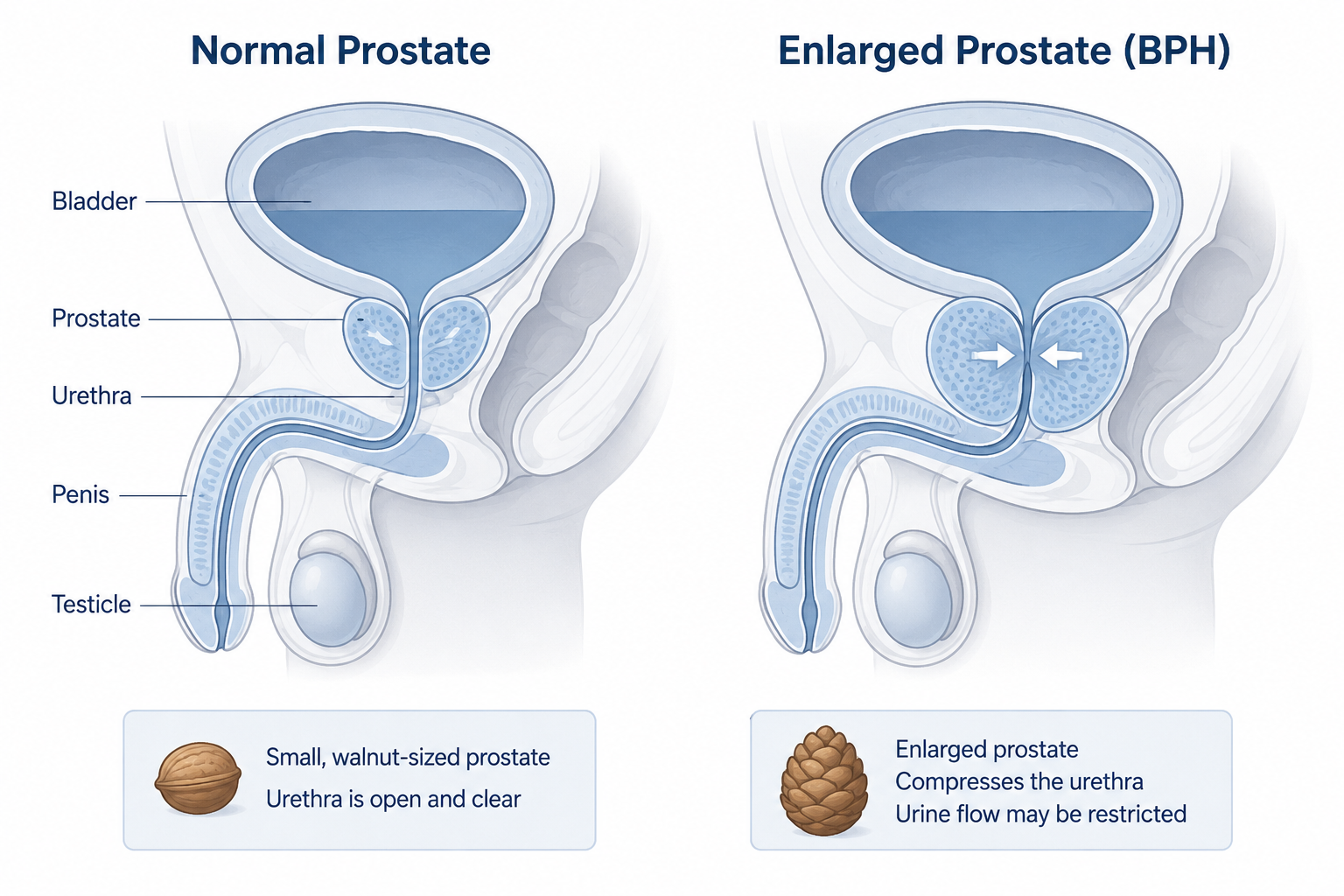
An enlarged prostate compresses the urethra, restricting flow and triggering the urgent, frequent urination that disrupts sleep.
5 Signs Your Prostate Is Affecting Your Sleep and Quality of Life
Nocturia is the most disruptive symptom, but BPH produces a cluster of signs that together paint a clear picture:
Waking up 2 or more times a night to urinate
This is the defining symptom of nocturia associated with BPH. It's not random — it follows a pattern: you fall asleep, the bladder reaches a lower threshold than normal, you wake with urgency. Each interruption fragments your deep sleep cycle, compounding fatigue, irritability, and cognitive impairment the next day.
A weak or interrupted urine stream
If it takes longer to start urinating, or the stream is thin, slow, or stops and starts, the urethra is being partially obstructed. Healthy voiding should be a continuous stream that empties the bladder in under 30 seconds. Difficulty or delay is a direct sign of urethral compression.
The feeling that the bladder never fully empties
Post-void residual urine — urine left in the bladder after voiding — is a key clinical sign of BPH. The bladder never fully empties because the urethra is partially blocked. This residual urine can become a source of recurring urinary tract infections and progressive bladder wall irritation.
Sudden, hard-to-control urges to urinate
The irritated bladder wall becomes hypersensitive, triggering sharp urgency signals even when the bladder contains only a small volume. This urgency can be embarrassing and disruptive during daily life — meetings, travel, exercise — not just at night.
Fatigue and cognitive fog that won't resolve
This one is underreported. Fragmented sleep from nocturia produces the same physiological consequences as insomnia: elevated cortisol, impaired memory consolidation, reduced testosterone production (which worsens the hormonal imbalance that's driving BPH in the first place), and chronic low-grade inflammation. It becomes a self-reinforcing cycle.
5 Evidence-Backed Strategies That Actually Help
The goal is to reduce DHT stimulation of the prostate, calm bladder irritation, and improve the conditions that allow restful sleep. These strategies directly target those mechanisms:
Stop drinking fluids 2–3 hours before bed
This is the simplest intervention and produces immediate results. Cut off all fluids — including herbal teas, which still add volume — by 7–8pm. Alcohol and caffeine are diuretics that increase urine production beyond their fluid volume; eliminating them after 4pm specifically reduces nighttime urgency in most men within days.
Reduce red meat and high-fat dairy consumption
Saturated fat from red meat and full-fat dairy is a substrate for DHT production. Multiple epidemiological studies show that men on plant-forward, low-saturated-fat diets have significantly lower rates of symptomatic BPH. Replacing red meat with fish (rich in omega-3s, which have anti-inflammatory effects on prostate tissue) two to three times per week is a practical step with measurable impact.
Exercise regularly — specifically aerobic activity
Sedentary men have significantly higher rates of BPH symptoms than active men. Aerobic exercise reduces systemic inflammation, improves pelvic circulation, and modestly lowers DHT levels by supporting healthy testosterone metabolism. 30 minutes of moderate cardio (brisk walking, cycling, swimming) five times per week is the evidence-backed minimum. Avoid prolonged cycling, which puts direct pressure on the prostate.
Add zinc and lycopene to your diet
The prostate has the highest zinc concentration of any organ in the body — and zinc deficiency is strongly associated with BPH progression. Pumpkin seeds, oysters, and beef liver are top sources. Lycopene — found in cooked tomatoes, watermelon, and pink grapefruit — has been shown in multiple studies to reduce prostate-specific antigen (PSA) levels and inhibit DHT-driven cell proliferation. Cooked tomatoes provide more bioavailable lycopene than raw.
Practice double voiding before bed
Urinate, wait 30–60 seconds, then try again. This technique — recommended by urologists — helps empty post-void residual urine that contributes to the early urgency signals that wake you up. Combined with pelvic floor exercises (Kegel exercises for men), double voiding can meaningfully reduce both frequency and urgency within 4–6 weeks of consistent practice.
The Role of Targeted Prostate Supplements
Diet and lifestyle changes are the foundation. But for men over 50 with established BPH symptoms, the hormonal and cellular changes already underway often require more targeted support to see measurable improvement.
Several plant compounds have well-documented mechanisms against DHT-driven prostate growth:
Saw Palmetto (Serenoa repens)
Inhibits 5-alpha-reductase — the enzyme that converts testosterone to DHT. Multiple placebo-controlled trials show significant reductions in nocturia frequency and improved urine flow within 4–8 weeks of consistent use.
Beta-sitosterol
A phytosterol that directly reduces prostate cell proliferation and inhibits the inflammatory prostaglandins that irritate the bladder wall. Clinical studies show improvements in peak urine flow rate and residual urine volume comparable to pharmaceutical alpha-blockers in some populations.
Pygeum africanum
Bark extract shown in a 2002 Cochrane review to reduce nocturia by 19% compared to placebo across multiple trials — with improvements in bladder capacity and post-void residual volume.
Stinging Nettle Root
Inhibits the binding of DHT to prostate cell receptors and has demonstrated anti-inflammatory effects on prostate tissue in both in-vitro and clinical studies. Frequently combined with Saw Palmetto for synergistic effect.
Clinical Recommendation
Prostavive: Prostate Support Formulated for Men Over 40
Prostavive combines Saw Palmetto, Beta-sitosterol, Pygeum africanum, and Stinging Nettle Root — the four plant compounds with the most consistent clinical evidence for reducing BPH symptoms. It's the formula we've reviewed that most directly addresses the DHT-driven mechanism described in this article, rather than simply masking urgency symptoms.
Disclosure: MD Clinical Reports earns a commission if you purchase through our links, at no extra cost to you. We only recommend products we have independently reviewed.